

Promotion: Capital invested is at risk. Non-Independent Research / Marketing Communication. Attention is drawn to the disclaimers and risk warnings within this document.
Wabigoon Greenstone Belt · Ontario · Canada
BROKER NOTE BY JONATHAN PLANT - August 2026
.png)
Richmond Hill Resources plc (“RHR”) has repositioned itself around the Martello Gold Project in Ontario, a consolidated, road-accessible gold exploration package in the Wabigoon Greenstone Belt with historic high-grade production, multiple documented occurrences and a credible district-scale exploration thesis.
Martello now comprises 145 mining claims covering approximately 5,685 hectares, following the acquisition of the original Martello claims, the adjacent Bartlett claims and the low-cost Esler claims. The significance of this consolidation is that the ground appears to bring together historically fragmented gold occurrences within a single structural framework, allowing RHR to evaluate the project as an integrated mineralised system rather than as a series of isolated prospects.
The principal investment case is not based on a blind grassroots discovery. Gold has been documented across the property for more than a century, including historic production from Sakoose at approximately 15 g/t Au and additional occurrences such as Maw and Tabor. The key questions are therefore scale, continuity, geometry and ultimately whether modern exploration can define a compliant resource of meaningful size.
RHR’s recent technical work has materially improved that question set. Historical data compilation, drone magnetic surveying, 3D magnetic inversion and the maiden Tabor drill programme have helped identify and rank seven priority targets across the project. Sakoose is the leading target because it combines historic high-grade production, an interpreted strike extent of more than 1.4 kilometres, multiple subparallel structures and several subordinate prospecting targets around the old workings.
The project’s infrastructure profile is a central advantage. Martello is located approximately 45 kilometres south-east of Dryden, Ontario, with road access, nearby services, available crews and a lower-cost operating environment than remote, helicopter-supported Canadian exploration projects. This matters because RHR is a micro-cap explorer and the value creation path depends on maximising drilling efficiency while limiting unnecessary dilution.
Near-term catalysts include permit progression, field validation at priority targets, assay results from the 35 rock-chip samples collected from Sakoose, Maw and Church Lake during the July 2026 field programme, and the proposed next phase of drilling focused on Sakoose. Positive results would support the district thesis and could justify a re-rating from a historic, high-grade exploration story toward a more systematic resource-definition opportunity.M14 There was a small uptick in share price on this field validation work showing that the market is watching.
The principal risks remain exploration risk, funding risk and dilution. The historic resource and production data are not compliant with modern reporting standards, and the interpretation of structural continuity must be confirmed by drilling. However, the combination of a consolidated land package, historic high grades, modern targeting and favourable logistics gives Martello a credible route to value creation if RHR can demonstrate continuity across the priority structures. We tweak the 18month share price target up to 12p to reflect the timeline of works required but also the enhanced value opportunity in Martello and potential read-through across the portfolio.
At first glance, RHR may appear to be a conventional pre-discovery explorer: a micro-cap company with a project that requires repeated rounds of drilling, capital raising and geological interpretation before a compliant resource can be defined.
That framing understates the quality of the starting point. Martello is not a blind grassroots concept; it is a consolidated gold system with historic high-grade production, multiple documented occurrences and a modern technical programme now designed to test whether those occurrences form part of a coherent district-scale structure.
Sakoose provides the strongest evidence base. Historic records indicate approximately 3,900 ounces of production at roughly 15 g/t Au, while the wider Martello footprint includes additional occurrences that support the possibility of repeated mineralised structures rather than a single isolated vein.
RHR has begun to convert that historic record into a modern exploration framework. Critical Discoveries Ltd has been engaged to rationalise legacy data, integrate the drone magnetic survey and 3D magnetic inversion model, and translate those inputs into ranked drill targets.
The result is a more disciplined exploration case: seven priority target zones have been identified, with Sakoose ranked first because it combines historic high-grade production, an interpreted strike length of more than 1.4 kilometres, structural complexity and multiple subordinate targets around the old workings.
The maiden Tabor drilling should be viewed primarily as calibration work rather than as a resource-definition programme. It validated geological controls, tested extensions to known mineralisation and improved the understanding of vein geometry, all of which helps sharpen the next phase of drilling.
The investment case therefore turns on definition rather than discovery alone. The central questions are whether RHR can demonstrate continuity, scale and geometry across the priority structures, and whether that work can support a compliant resource of meaningful size.
Martello’s logistics strengthen that case. Road access, proximity to Dryden, local services and lower mobilisation costs mean the company can test more metres per pound raised than a remote, helicopter-supported explorer, reducing the dilution burden that typically limits micro-cap exploration stories.
Near-term value creation now rests on a simple sequence: assays from the July 2026 sampling, permit progress and the proposed Sakoose-focused drill programme. Potential positive results could strengthen the case for Martello as a connected gold system, not just a collection of historical showings.M14
The geology section can be read simply: Martello is not a blank-sheet prospect. Ontario Geological Survey records, Delisle’s Dryden-area work and later technical notes document a long history of gold showings, old workings, visible-gold quartz veins and a non-compliant historical resource at Sakoose. The modern opportunity is to test whether those fragmented records form part of a larger, repeatable district system.M7,M8,M9,M10,M13
The important point is that the historical material has value, but not as a current resource. It provides evidence of grade, fertility and structure; RHR still has to prove continuity, geometry and scale through modern drilling before any compliant resource value can be claimed.M7,M8,M9,M10,M13
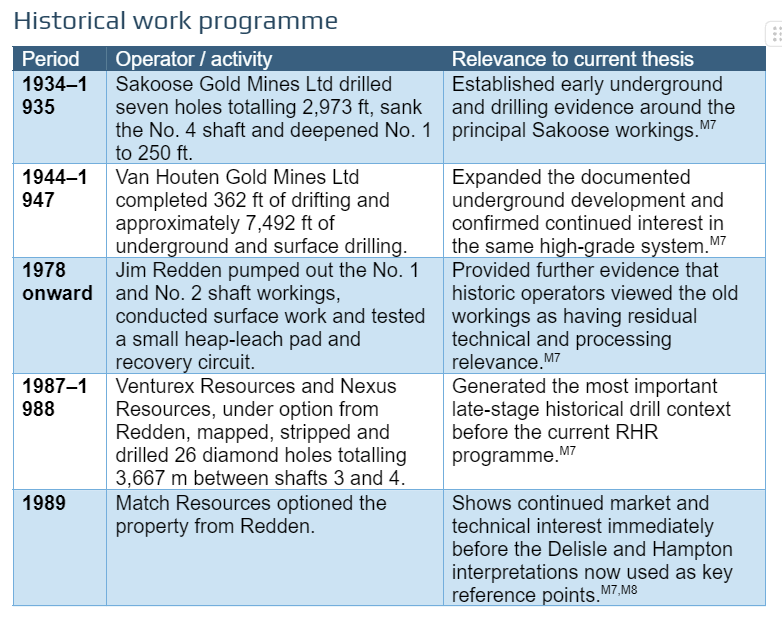
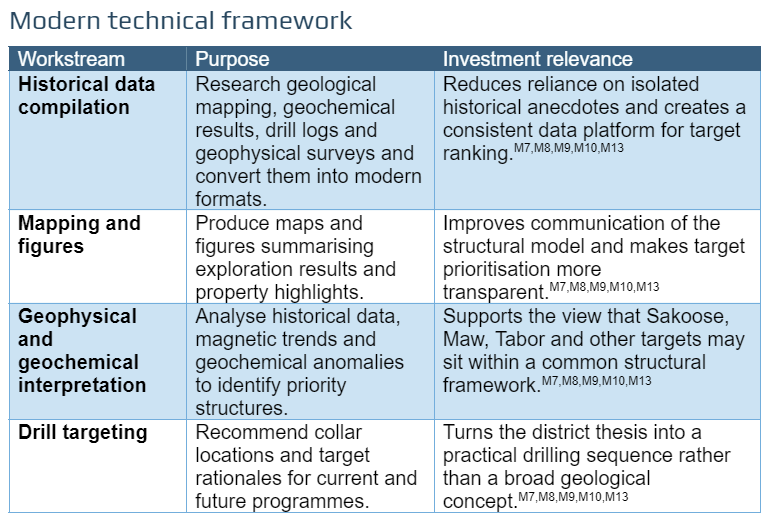
Seven priority targets were identified for the maiden campaign, with approximately 1,370 m of planned drilling. The wider exploration case is anchored by Sakoose and Maw because both have specific historical descriptions, structural settings and visible-gold quartz vein evidence, while Tabor has provided recent calibration data for the broader system. The 13 July 2026 field programme has now added ground-truthing across Sakoose, Maw and Church Lake, with 35 rock-chip samples submitted for gold and multi-element analysis and assay results expected during Q3 2026M7-10,M13-14.
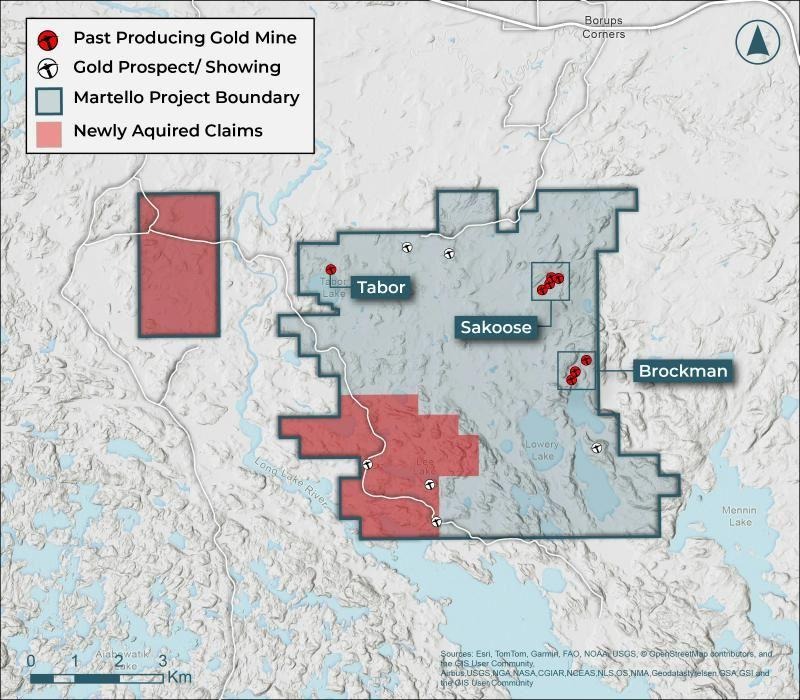
Figure 1. Regional Martello map showing Tabor and Sakoose within the broader project areaM3.
For context, the cited Ontario Geological Survey terminology distinguishes between an occurrence, a prospect and a mine: an occurrence has had less than 600 m of diamond drilling; a prospect has underground development or more than 600 m of diamond drilling plus significant surface work; and a mine is a former producer of any amount of the commodity.M8
Martello lies within the Wabigoon greenstone setting and is underlain by mafic volcanic, sedimentary and felsic intrusive rocks. The key exploration relevance is structural: gold-bearing quartz veins appear to be controlled by dike contacts, lithological contacts, shears and fold-related traps rather than by a single simple vein.M7,M8
Delisle’s mapping provides the strongest description of Sakoose and Maw. At Sakoose, a felsic dike appears to control much of the gold-bearing shear zone, with quartz veins, pods and lenses developed around dike contacts, shaft areas and fold-related settings. Maw adds nearby repetition, with saddle-reef and oblique shear-hosted veins. The July 2026 field programme adds current validation: at Sakoose, the historically mined quartz vein was observed locally varying from approximately 15 cm to 2 m in thickness, with additional quartz veinlets and widespread hydrothermal alteration in quartz-feldspar porphyry and surrounding metabasalt.M7,M8,M14
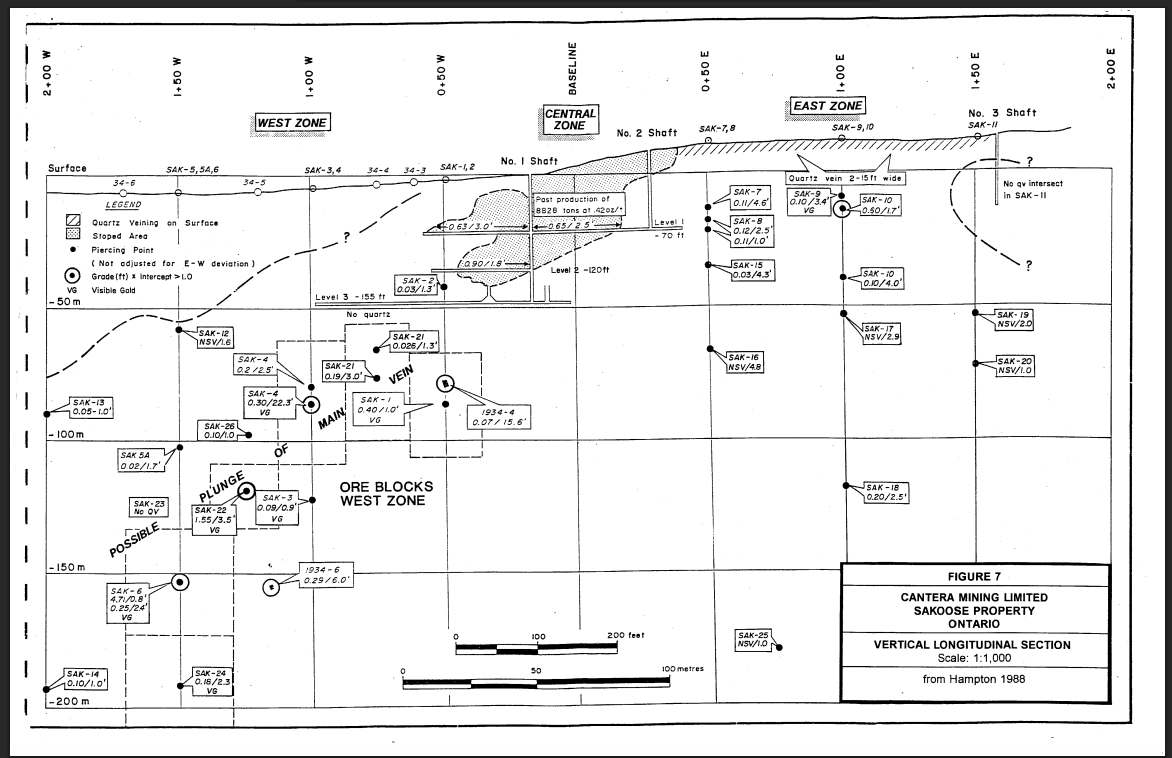
Figure: Sakoose geology map showing the historical shaft area, mapped vein settings and the interpreted structural controls around the Sakoose–Maw corridor. Source: Ontario Geological Survey / Delisle property visit mapping and Hampton historical interpretation, as cited in M7, M8 and M13.
In effect he was suggesting a district-scale, multi-target approach that RHR is now initiating.
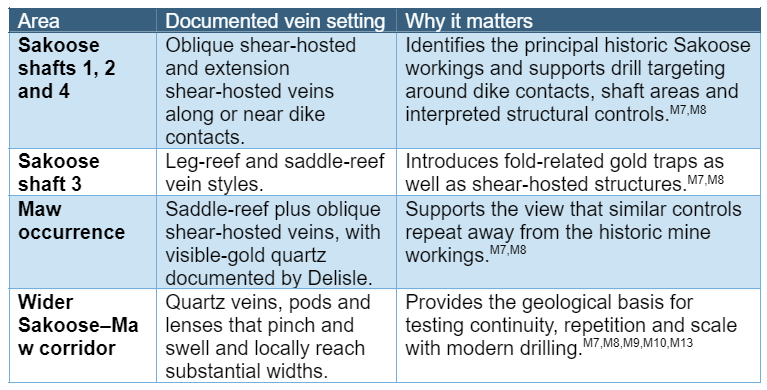
Maw matters because it shows the system may repeat away from the old Sakoose shafts. Saddle-reef geometry points to fold-hinge traps, while oblique shear-hosted veins add a second structural setting nearby. The July 2026 reconnaissance also recorded quartz veins and veinlets at Maw within gabbro and quartz-feldspar porphyry dykes, with several structural orientations mapped and one sample collected from a stockpile at the principal historical working.M7,M8,M14
That makes Maw a useful miniature of the district thesis: the same broad mineralising system seen at Sakoose appears nearby in a different fold-controlled expression. Church Lake adds another field-validated target, with quartz veins, historical workings and multiple structural trends mapped during the July 2026 programme, although vegetation limited exposure in parts of the area.M7,M8,M9,M10,M13,M14
Ontario Geological Survey records summarise the documented output and a historical resource estimate:
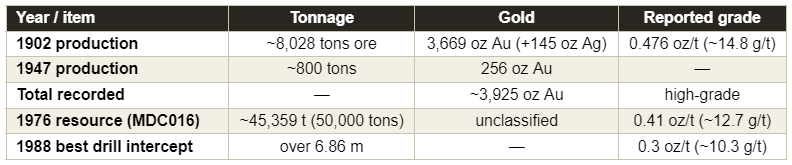
These figures are historical and are sourced from Ontario Geological Survey records; they are not reported under NI 43-101 or JORC and should not be treated as current mineral resources. They remain important because they substantiate the high-grade character of the system, including the approximately 14.8 g/t historical production grade and the reported 1988 intercept of approximately 10.3 g/t over 6.86 m.M7,M8
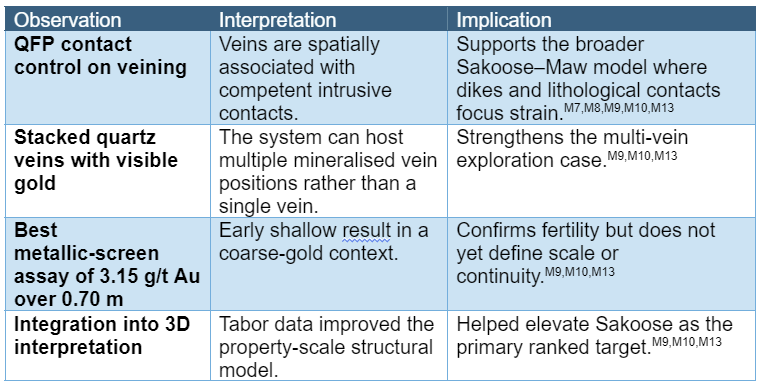
The maiden Tabor programme should be read primarily as calibration drilling rather than as resource-definition drilling. Seven holes, TB-26-001 to TB-26-007, were completed for an aggregate 1,307 m, testing the Tabor system, validating historical concepts and helping define the parameters of the broader Martello model.M9,M10,M13
The programme confirmed quartz–feldspar porphyry contact control on veining, intersected stacked quartz veins with visible gold in hole TB-26-002 and returned a best metallic-screen assay of 3.15 g/t Au over 0.70 m. In a coarse-gold setting, this is more useful as geological confirmation than as a standalone grade result.M9,M10,M13
The key output from Tabor was therefore interpretive: it helped validate the structural model, improve the 3D target framework and sharpen the rationale for ranking Sakoose as the highest-priority target for the next phase of work.M9,M10,M13
Grade context remains important, but it should be handled with discipline. Historic production at Sakoose, visible-gold quartz veins, grab samples, channel samples and isolated drill intercepts are evidence of a fertile high-grade system; they are not substitutes for modern drilling, compliant resource estimation or continuity testing. The July 2026 rock-chip samples are therefore best viewed as a potential near-term validation catalyst for a wider system: positive assays could strengthen target ranking and drill planning, but they would still need to be followed by drilling to test continuity and geometry.M7,M8,M9,M10,M13,M14
In coarse-gold systems such as Sakoose, Maw and Tabor, conventional fire assays can under-report grade because a single coarse gold particle may or may not be captured in a small analytical charge. This is why metallic-screen fire assays are relevant over visible-gold intervals, and why historical high-grade samples should be read as indicators of fertility rather than estimates of average grade.M7,M8,M9,M10,M13
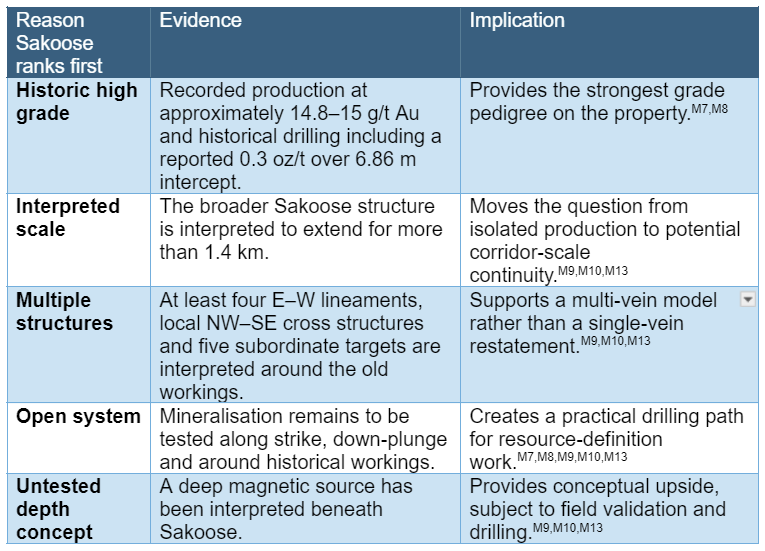
Sakoose ranks first because it combines four things that matter most at this stage: historic high grade, interpreted strike, structural repetition and a clear first drill test. The investment point is simple: RHR is not just re-visiting an old mine; it is testing whether the old workings sit within a broader corridor of repeated, drillable structures.M7,M8,M9,M10,M13,M14
The current model links Sakoose to E–W and ENE–WSW corridors cut by NW–SE structures, with at least four interpreted E–W lineaments, several gold-in-soil coincidences and July 2026 field observations of additional quartz veinlets and hydrothermal alteration beyond the historically mined vein. That supports a multi-structure test rather than a single-vein restatement.M9,M10,M13,M14
The deep magnetic feature beneath Sakoose is best treated as blue-sky upside, not evidence of depth continuity. Its value is sequencing: if shallow drilling supports continuity, the magnetic feature becomes a later, testable depth concept rather than a current valuation driver.M9,M10,M13
The wider target portfolio gives Martello optionality beyond Sakoose. The priority targets share variations of the same structural controls, particularly E–W to ENE–WSW trends, cross-cutting structures and magnetic features that can be ranked and tested in sequence.M9,M10,M13
The table below summarises the practical role of the key targets in the current exploration model.
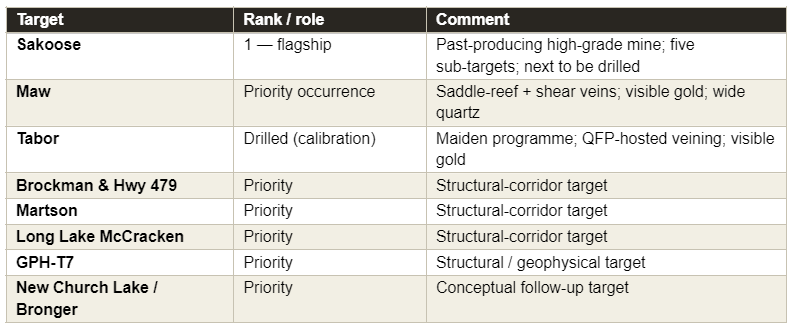
Each target is an independent opportunity to test a related mineralising system, but the value of the portfolio lies in sequencing: Sakoose provides the highest-grade historical anchor, Maw tests nearby fold- and shear-hosted repetition, Tabor calibrates the model with recent drilling, and Church Lake now adds a ground-truthed target with quartz vein occurrences, historical workings and multiple structural trends. The remaining targets test whether the same structural architecture repeats across the broader claim package.M7,M8,M9,M10,M13,M14
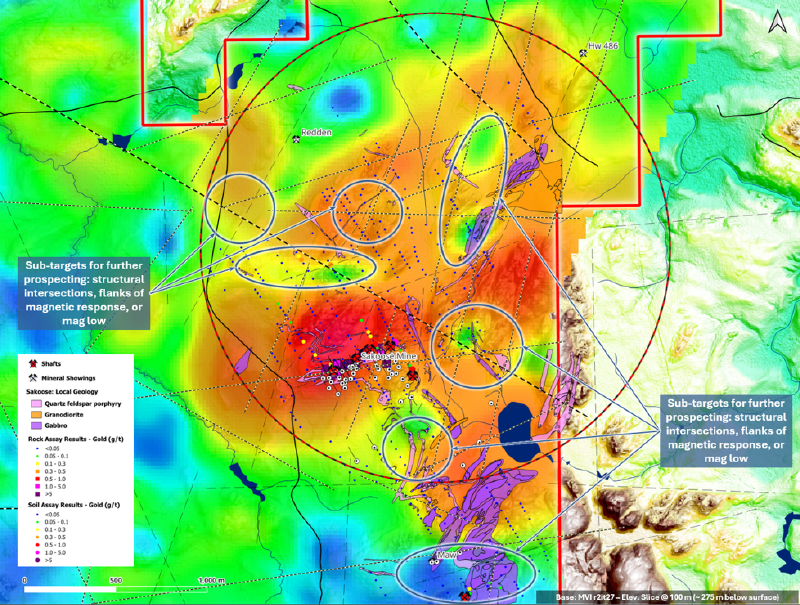
Figure 3. Sakoose detail map showing the historic workings and five subordinate prospecting targets identified around the Sakoose area.M3
Martello’s infrastructure profile is part of the investment case, not a secondary detail. The project is road-accessible, close to Dryden and positioned in established forestry and mining service country, so RHR should be able to direct more of each exploration pound into drilling, sampling and target validation rather than camp construction, aviation support or remote logistics.M2,M7
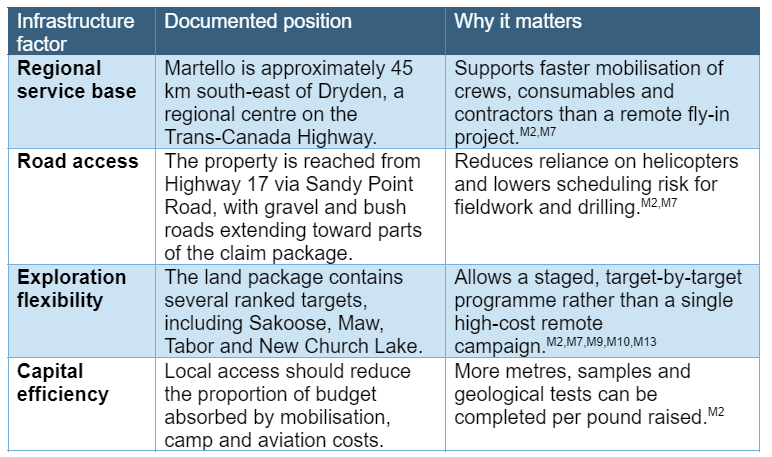
The practical implication is straightforward: road access, nearby services and target sequencing should lower all-in exploration cost relative to remote aviation-supported programmes, while allowing RHR to test Sakoose first and then move through Maw and the wider portfolio if results justify it. Exact cost per metre will still depend on contractors, season, hole design, assay scope and mobilisation requirements.M2,M7,M9,M10,M13
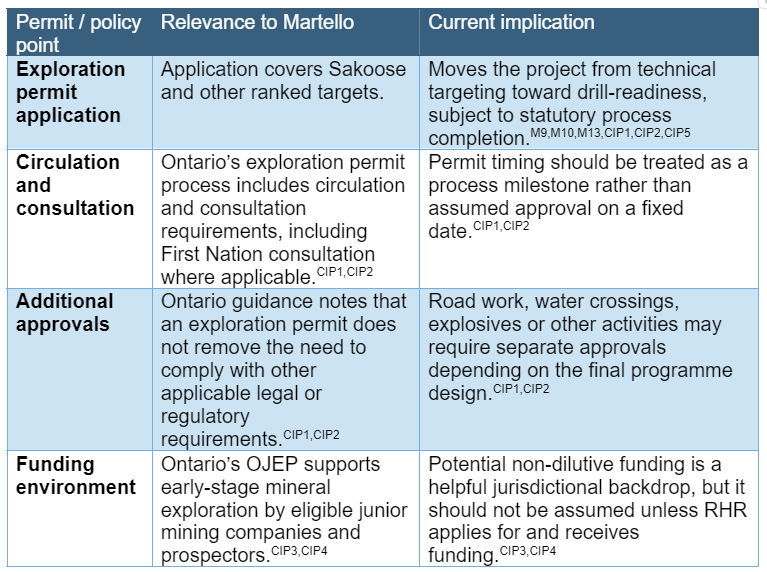
RHR has submitted an exploration permit application covering Sakoose and other priority targets within Martello.M9,M10,M13,CIP5 The application was circulated by the Ontario Ministry of Energy and Mines on 11 June 2026 and is progressing through the statutory consultation process,CIP1,CIP2 linking the technical ranking exercise to the next physical work programme.
The gold backdrop is supportive, but it should remain context rather than dominate the note. The strongest structural point is that official-sector demand remains material: central banks continue to treat gold as a reserve-diversification asset, Q1 2026 demand was supported by continued official-sector buying and reserve-management work still frames gold as a useful diversifier alongside foreign-exchange assets.G1,G2,G7
Asia adds a second dimension. China’s official reserve accumulation and tightening of leveraged retail gold trading point to a market being pushed away from speculative paper access and toward more controlled, physical or non-leveraged channels, while Hong Kong’s new central clearing and settlement system is designed to deepen physical delivery, storage, price discovery and connectivity with the Mainland gold market.G3,G4,G5
Two charts frame the reserve argument. Foreign central banks’ gold holdings have overtaken their US Treasury holdings as a share of reserves, signalling a symbolic shift toward hard assets, but this should not be read as a one-way rejection of Treasuries. Foreign private investors have simultaneously become more important buyers of US Treasuries, meaning official-sector diversification can coexist with private-sector demand for dollar debt when yields are attractive.G10,G11
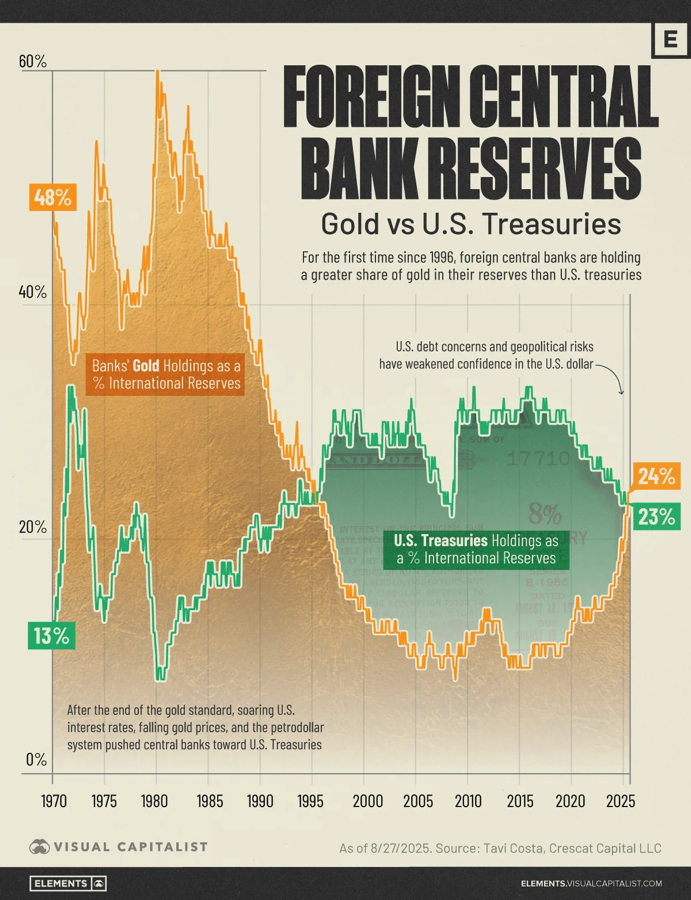
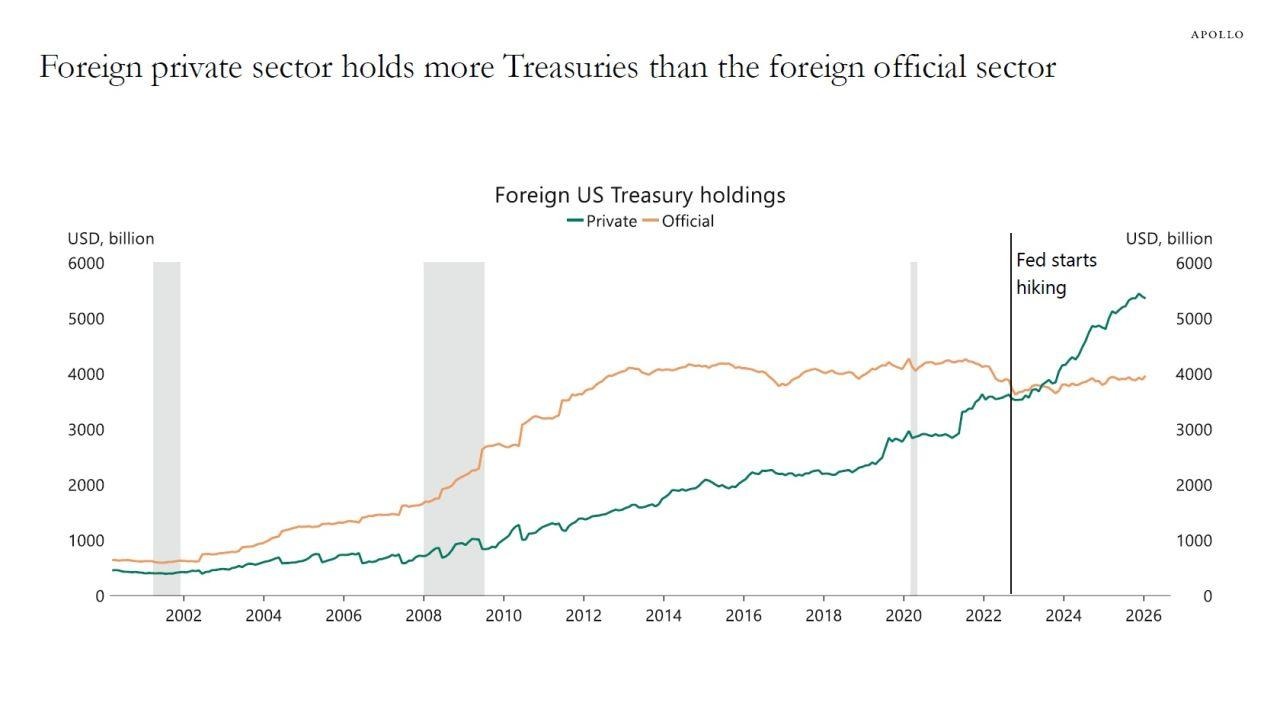
The speculative layer is more fragile. Gold ETF flows show that investors can chase the move at the highs and then unwind quickly: June 2026 saw broad gold ETF outflows even though first-half flows remained positive overall. For RHR, that makes the gold backdrop useful but not decisive: it can improve appetite for high-grade junior exploration, but the re-rating still has to come from Martello-specific progress rather than from the gold tape alone.G9
The investment implication is therefore simple: assays, permit progress, Sakoose drilling, continuity evidence and disciplined funding matter more than macro endorsement. A supportive gold market may make investors more willing to fund the sequence, but only drilling can move Martello from historic high-grade optionality toward a credible resource pathway.
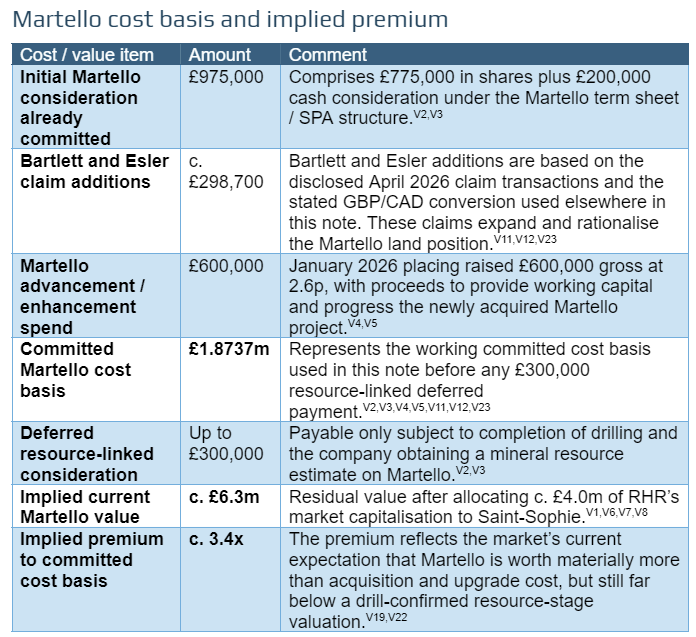
Valuation is difficult because Martello is still pre-resource. There is no compliant NI 43-101 Mineral Resource Estimate, no mine plan and no basis for a formal DCF or NAV. The useful starting point is therefore simpler: what value is the market already assigning to Martello, what has RHR committed to acquire and advance it, and what evidence would justify moving that value higher?V1,V2,V3,V4,V5,V8,V9,V19,V22
Following the 13 July 2026 field-programme update, RHR’s share price moved to approximately 1.4p and the market capitalisation increased to approximately £10.29m. The working allocation in this note remains deliberately simple: assign approximately £4.0m to Saint-Sophie and treat the residual c. £6.3m as the implied market value of Martello.V1,V6,V7,V8,V10,M14
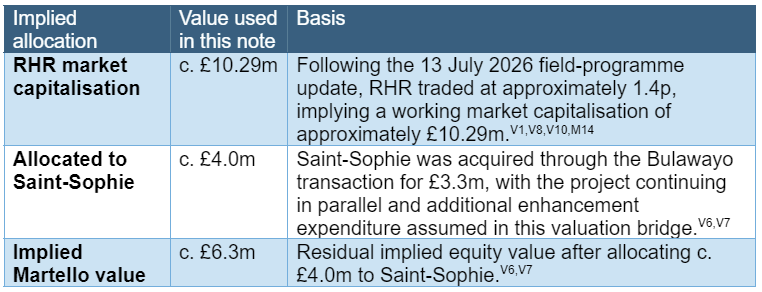
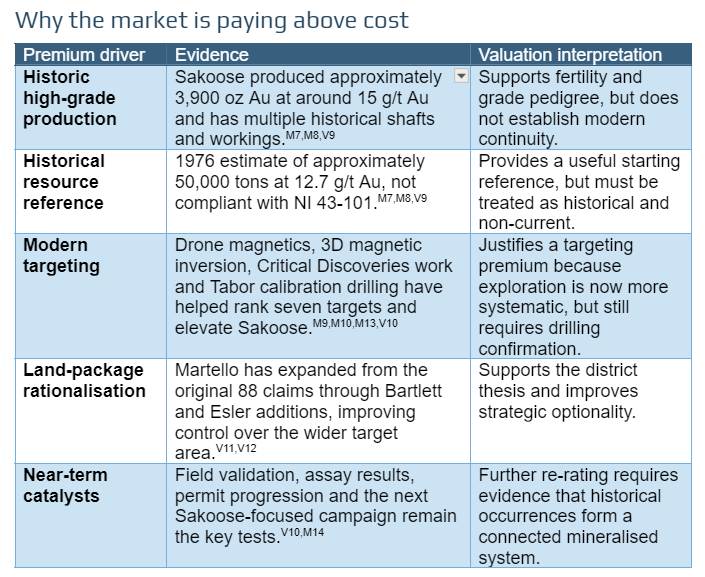
Because Martello has no current NI 43-101 resource, the valuation framework should be read as a staged progression rather than a resource claim: historical evidence supports option value; drilling can support an inferred-resource framework; only later technical studies can support NAV-style valuation.M7,M8,V9,V13,V14,V15,V19,PC12,PC13,PC14,PC20,PC21
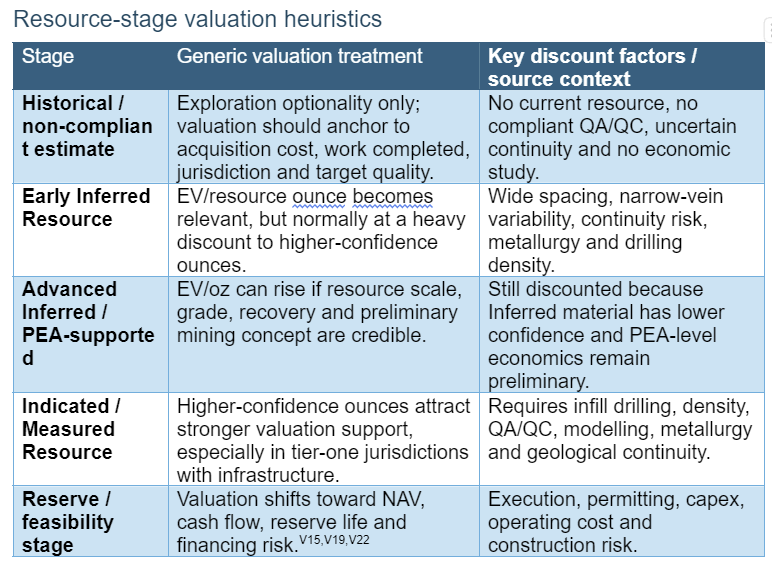
The 1976 Sakoose estimate is best treated as a historical pocket reference, not a district resource. The reported figure was 50,000 tons at 12.7 g/t Au. If interpreted as short tons, that equates to approximately 45,359 tonnes, 576,059 grams of contained gold and approximately 18,520 oz Au. If interpreted as metric tonnes, the same calculation produces approximately 20,416 oz Au. The appropriate working range is therefore c. 18,500–20,400 historical, non-compliant ounces.M7,M8,V9
Calculation step
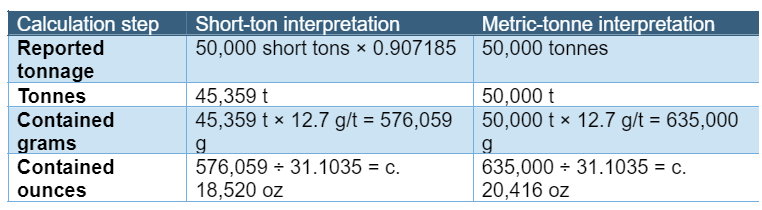
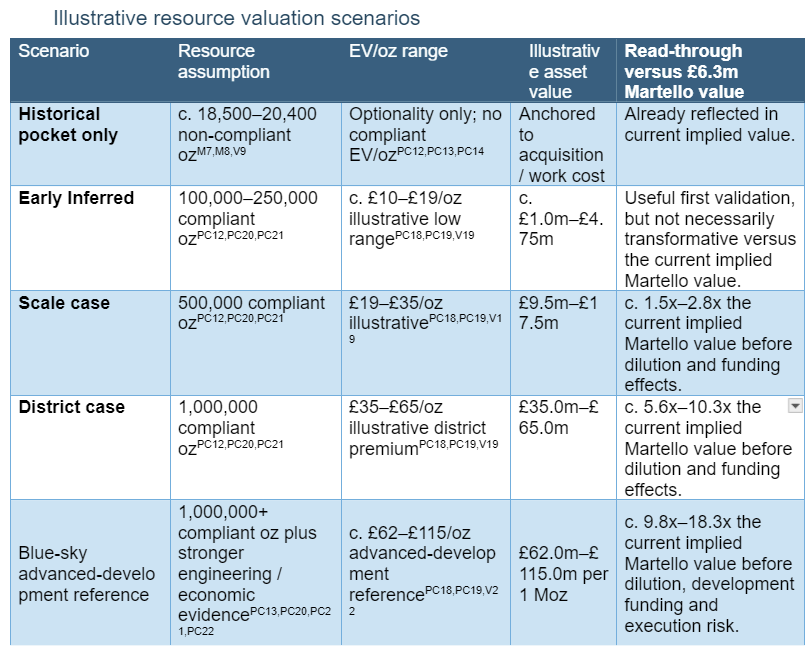
Valuation matrix note: the £19–£35/oz range is intended for early-to-improving Inferred-resource scenarios and is a sterling approximation of a US$25–45/oz heuristic, converted at an illustrative GBP/USD rate of 1.30. The lower £10–£19/oz range reflects a wider early-resource haircut for lower confidence, wider drilling, narrow-vein variability and the absence of engineering studies. The £35–£65/oz district range reflects a premium for larger compliant scale, grade, tier-one jurisdiction, infrastructure and evidence of repeated mineralised structures. The blue-sky advanced-development reference converts a US$80–150/oz rule-of-thumb range at the same illustrative GBP/USD rate and should only be considered if
Martello moves beyond a simple Inferred-resource case into a 1Moz+ resource with materially stronger engineering, metallurgical and economic evidence. These ranges are market heuristics, not formal standards, and should be cross-checked against live peers and transaction evidence.V19,V22,PC18,PC19
District valuation should be read as a ladder. At the current stage, Martello is valued on cost, jurisdiction, infrastructure, targeting and option value. If drilling supports a compliant resource, EV/resource ounce becomes relevant. NAV or DCF only becomes appropriate once there is enough technical work to support mine design, recoveries, capex and operating assumptions.PC18,PC19,PC20,PC21,PC22,V22
The company has not disclosed the size of the next post-Tabor campaign, so the drilling budget in this note is an analyst scenario. The logic is simple: RHR does not need reserve-style drilling to start, but it does need enough modern pierce points to show whether Sakoose has geological and grade continuity across the interpreted corridor.M9,M10,M13,PC12,PC20,PC21
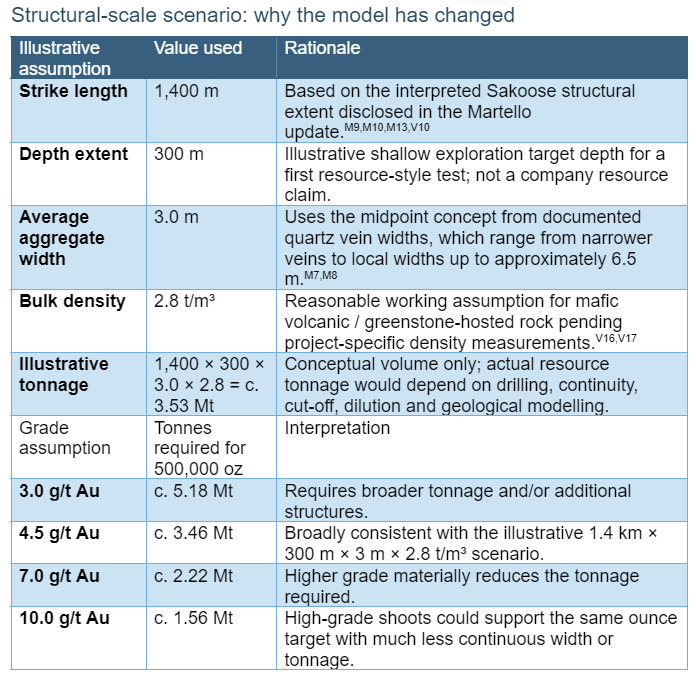
Using a 1.4 km corridor and an initial 300 m depth test, a simplified grid implies roughly 84 pierce points. At an average inclined hole length of about 110 m, that equates to approximately 9,240 m of drilling, consistent with the 7,000–10,000 m expanded inferred-grid scenario used below. The exact metreage would depend on orientation, spacing, vein continuity, use of historical data and whether multiple subparallel structures can be tested from the same collars.M9,M10,M13,PC12,PC20,PC21
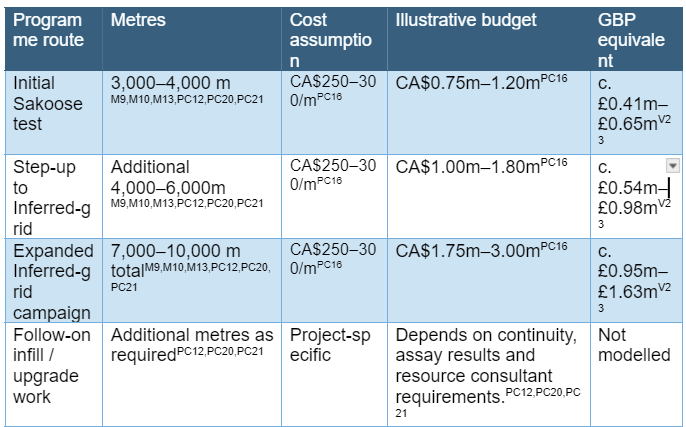
GBP equivalents use an illustrative GBP/CAD rate of 1.846, consistent with the exchange rate already used in this note for the Bartlett and Esler claim conversion. The step-up route is the most realistic funding pathway: RHR could complete an initial Sakoose test first, then raise or deploy incremental capital only if early results justify expanding toward a resource-style grid. Actual sterling funding needs will vary with exchange rates, contractor terms and programme scope.V23
Dryden Gold’s disclosed all-in drilling cost reference of approximately CA$250/m provides a useful local benchmark for road-accessed northwestern Ontario drilling, but RHR’s actual cost per metre will depend on contractor availability, hole depth, assay scope, core handling, season and mobilisation. The absence of helicopter mobilisation should help, but it does not remove the need for a meaningful capital raise if RHR intends to move Sakoose toward a resource-style drill grid.PC16
For dilution purposes, this note uses the 735.248m post-Bartlett share count as the starting fully paid/basic position. This reflects the 718.264m ordinary shares reported at the 31 March 2026 half year plus the 16.984m Bartlett consideration shares, which are treated here as already funded/economically committed even if the timing of formal issue/admission differs. Following the 13 July 2026 field-programme update, the share price moved to approximately 1.4p and the market capitalisation to approximately £10.29m; this section therefore uses 1.4p as the current reference financing price for dilution sensitivity. The April 2026 option grant RNS stated that total options outstanding were 63.26m; on the 735.248m starting base, simple fully diluted shares are therefore approximately 798.5m before any new financing, excluding any undisclosed warrants or later option grants not identified in the public sources reviewed.V1,V20,V21,SS1,SS2,SS3,M14
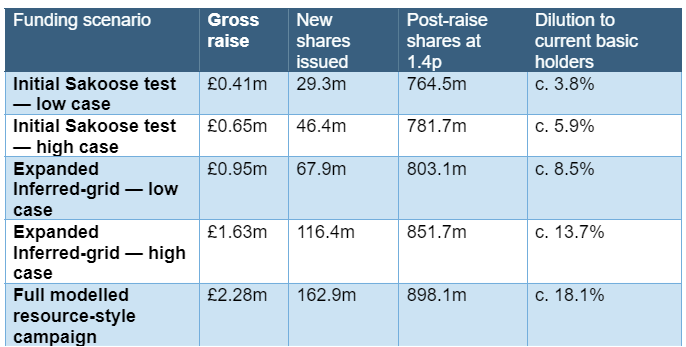
The final row combines the high end of the initial Sakoose test and the high end of the expanded Inferred-grid campaign for a simplified full resource-style funding case. It is deliberately conservative because it excludes issue costs, possible warrant sweeteners, working-capital buffers and any proceeds from option exercise.
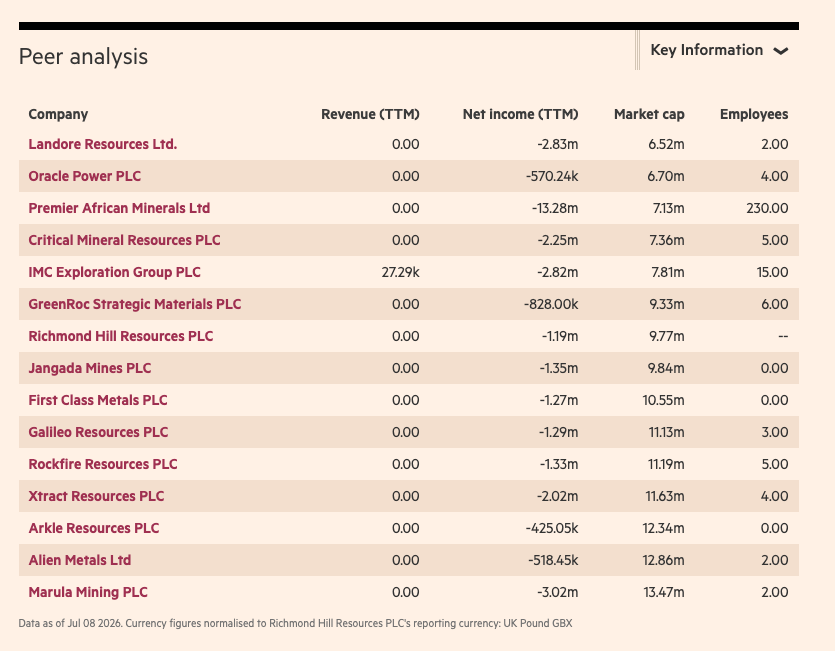
Source: note PC1
The peer comparison should do one job: explain the evidence gap. RHR trades within the range of its peers shown abovePC1 but well below better-funded Ontario gold explorers because Martello is still pre-resource and Sakoose has not yet been systematically drilled.PC1,M14 For instance, Dryden Gold commands a materially higher valuation because it has advanced a Wabigoon district story with repeated mineralised structures,PC7 a large 2026 drill programme,PC8 and strategic backing from Centerra GoldPC15 and Alamos Gold.PC15 The upside case is that, in our view, Martello has the ingredients peers are rewarded for — high-grade history, consolidated ground, infrastructure and a district thesis — but it still needs drill confirmation before the market could value it like a de-risked Ontario exploration platform, such as GFG ResourcesPC3 at the active regional-exploration stage, WallbridgePC4,PC9 at the resource-backed discovery stage or New Found GoldPC5,PC10,PC11 at the more advanced discovery-platform and consolidation stage.
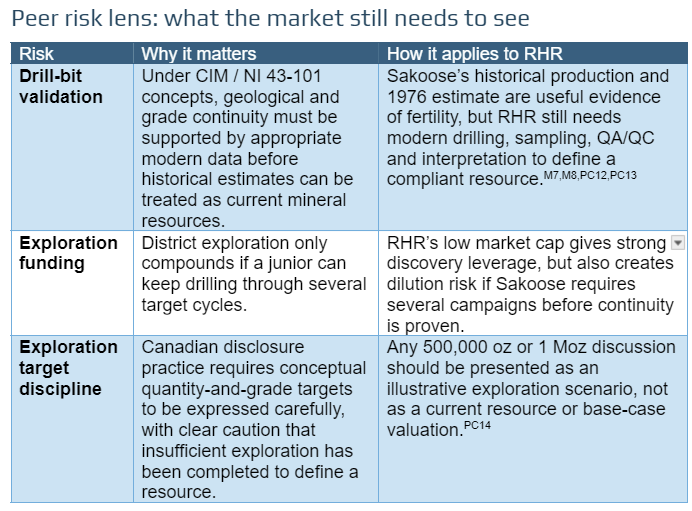
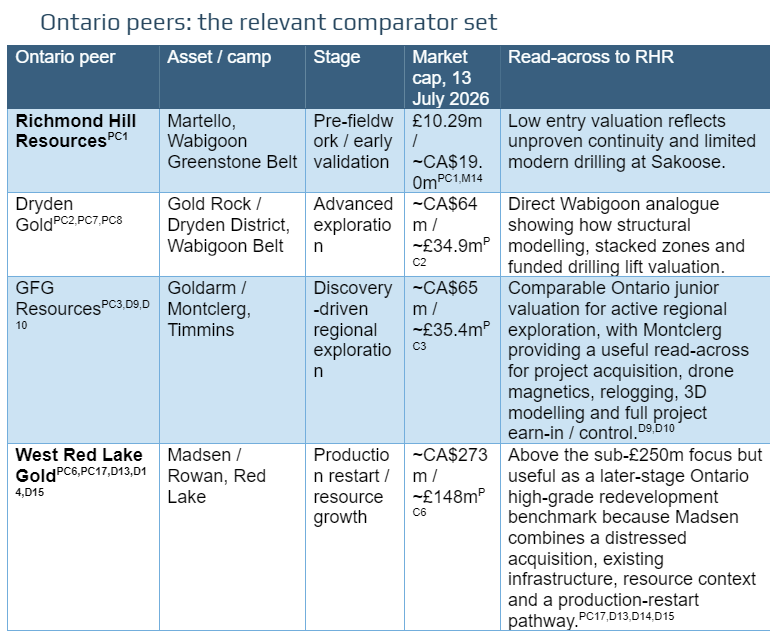
Table FX note: GBP equivalents use the GBP/CAD rate of 1.846 applied elsewhere in this note.
Dryden Gold is the most useful analogue because it shows how a Wabigoon gold story can re-rate once the evidence base becomes specific. Its higher market value provides the valuation read-across,PC2 while the technical case is supported by reported repeated mineralised structures at Gold Rock,PC7 a 45,000 m 2026 drill campaign,PC8 and strategic investment from Centerra Gold and Alamos Gold.PC15 Its disclosed CA$250/m drilling-cost reference is also useful for benchmarking road-accessed northwestern Ontario exploration costs.PC16 RHR is earlier and riskier, but that is precisely why the upside remains more asymmetric if Sakoose drilling begins to close the evidence gap.
Recent gold-sector M&A is useful only as strategic context, not as evidence that Martello is an immediate takeover target. The relevant read-through is narrower: Ontario’s policy backdrop remains supportive for mine development and capital investment,D1 EV/resource-ounce and NAV-style metrics are useful only once a project has sufficient resource or study definition,D2,D3 and strategic investors can validate earlier district stories before formal development if the geology and funding case are credible.PC15 For RHR, the nearer-term opportunity is therefore more likely strategic funding, a JV, farm-in or industry validation if Sakoose drilling works.
The important discipline is comparability. Greenstone is useful as an Ontario consolidation example because Equinox bought out Orion’s 40% interest and later consolidated 100% ownership of the mine,D4,D5,D6 while Valentine shows the premium attached to a more advanced development platform with reserves, resources and a near-term production plan.D16,D17,D18 Madsen is a redevelopment and infrastructure case, not an early exploration benchmark,D13,D14,D15 and Hemi is a large-scale development transaction with a resource, reserve and A$5bn control premium context.D7,D8,D19 These examples show where the valuation ladder can lead if drilling, resource definition, infrastructure and financing evidence are progressively added; they do not set a current transaction multiple for Martello.
Explorer-level transactions also matter because district consolidation can happen before production or even before a mature development study: Kenorland’s Central Uchi / Golden Sidewalk acquisition shows how juniors can assemble larger Ontario greenstone positions around a coherent belt-scale thesis.D11 AIM funding precedents are relevant too: targeted raises such as First Class Metals’ £1m Ontario placing show that small-cap explorers can raise discrete amounts for named exploration programmes, which is the type of staged financing RHR is likely to require if Sakoose results justify the next drill phase.D12
That leaves a simpler conclusion: RHR should be valued today on evidence and sequencing, not takeover speculation. Peer and deal evidence matter because they define the pathway — better drilling evidence, stronger funding quality, strategic validation and eventually compliant resources — not because they set a current transaction multiple for Martello.
RHR enters the second half of 2026 with a clear near-term catalyst sequence centred on Sakoose, now reinforced by the completion of the July 2026 field reconnaissance and rock-sampling programme across Sakoose, Maw and Church Lake. Near-term value creation depends on assay results, permit progress, drilling and interpretation; full mine development, if ever achieved, would be a multi-year process involving resource definition, economic studies, permitting, financing and construction.M3,M14,T1,T2,T3,T4
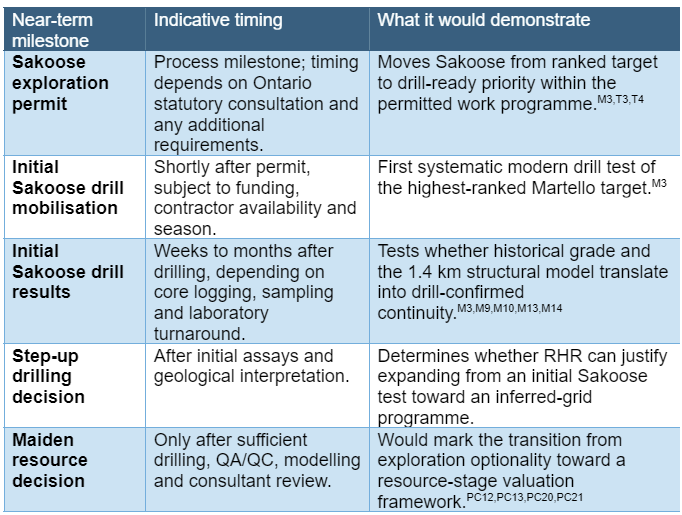
Exploration companies often move quickly between catalysts, but the full mining lifecycle is slow. A useful rule of thumb is that exploration and discovery can take several years, resource definition and economic studies add further years, and mine permitting, financing and construction are highly project-specific. RHR’s immediate investment case is therefore not mine production; it is whether Sakoose can move from historical and geophysical evidence toward drill-confirmed continuity.T1,T2,T3,T4,PC12,PC13
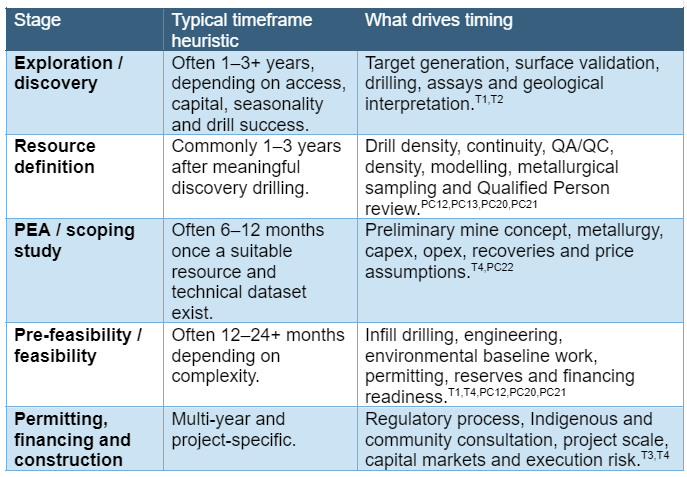
Catalyst watch: the most important near-term events are assay results from the July 2026 field samples, permit grant, rig mobilisation, first Sakoose collars, drill assay results and the decision whether to step up into a broader inferred-grid programme. The key value test is not production timing; it is whether RHR can demonstrate that Sakoose is a connected, drill-confirmed high-grade structure rather than a historical pocket.M3,M9,M10,M13,M14,PC12,PC13
Each milestone is discrete and value-relevant, but capital availability will determine pace. The road-accessed setting should help RHR move more efficiently than a remote fly-in explorer, yet any transition from initial Sakoose testing to a resource-style grid will almost certainly require additional equity funding. That is not unusual for a pre-revenue explorer; the key question is whether early results justify the dilution required for the next stage.
As at the 31 March 2026 half year, RHR reported approximately 718m ordinary shares in issue. This is the appropriate baseline share count for the valuation and dilution analysis in this note, with any subsequent financing or option exercise treated as incremental dilution rather than part of the starting equity base.
Subsequent disclosed issuance means the 31 March 2026 half-year figure should be treated as the analytical baseline rather than the latest legal share count. The Bartlett acquisition added 16,983,827 consideration shares at 1.75p per share, taking disclosed issued share capital to 735,248,168 ordinary shares following admission. Those Bartlett consideration shares are subject to lock-in release in four equal instalments on 15 October 2026, 15 April 2027, 15 June 2027 and 15 October 2027.SS1,SS2
Options and warrants are the main disclosed equity-linked overhangs. On 27 April 2026, RHR granted 31.0m director options exercisable at 2p and expiring on 31 March 2028. Following that grant, total options outstanding were 63,262,071, representing 8.6% of the then issued share capital. The company also discloses 148.45m warrants outstanding in the capital structure used in this note.
On the disclosed 735.25m post-Bartlett share count, simple fully diluted shares would therefore be approximately 946.96m before any new financing, warrant issue, option exercise proceeds or later option grants.SS3
The principal known deal consideration still to come is cash rather than shares: the original Martello term sheet provides for £50,000 payable on or before 31 October 2026, £50,000 payable on or before 31 March 2027, and further deferred consideration of up to £300,000 in cash subject to completion of drilling and RHR obtaining a mineral resource estimate on Martello. No additional share issuance for that deferred Martello consideration has been identified in the cited public terms, although future equity financing may still be required to fund drilling and working capital.SS4,SS5
Richmond Hill Resources offers a concentrated, early-stage gold exploration opportunity built around a simple strategic question: can the company convert Martello’s historic high-grade evidence into a modern, drill-confirmed district-scale gold system? The answer is not yet proven, but the starting point is materially stronger than a blind grassroots exploration story. Sakoose has recorded high-grade historic production, Maw and Tabor support repetition of similar structural controls, and modern drone magnetics, 3D inversion and target ranking have created a more disciplined drill sequence across the wider claim package.
The opportunity is therefore asymmetric but conditional.
RHR is positioned before the main Sakoose drilling decision point, where a relatively modest initial programme could materially change the probability assigned to the Martello thesis. If drilling confirms continuity, grade and repeated structures, the project could move from historic-optionality value toward a resource-definition pathway.
That is the point on the Lassonde Curve where micro-cap explorers can re-rate quickly, especially when the asset is in a tier-one jurisdiction, is road-accessible, and sits in a gold market where senior producers and larger juniors are actively looking for credible pipeline assets.
The valuation work in this note frames the opportunity as a staged project-valuation exercise rather than a single forecast. Following the 13 July 2026 field-programme updateM14, RHR traded around 1.4p with a market capitalisation of approximately £10.29m, implying Martello at approximately £6.3m after allocating c. £4.0m to Saint-Sophie (as we showed in the Martello costs basis part of the valuation section), compared with a committed Martello cost basis of approximately £1.8737m before any contingent resource-linked consideration becomes due . That updated Martello value now rewards consolidation, modern targeting, July field validation and near-term assay/drilling optionality, but it still sits below the illustrative valuation waypoints generated in the resource-stage analysis.M14.
The peer and transaction analysis reinforces that this is an evidence-gap story rather than a simple mispricing. Our opinion is that RHR currently trades below better-funded Ontario and Wabigoon exploration peers because Martello has not yet produced systematic Sakoose drill confirmation or a compliant resource. However, those same peers and recent district-scale transactions show why the prize can expand quickly if drilling converts historic high-grade evidence into a credible resource pathway. The deals section is not used here to argue that RHR is an immediate M&A target; it shows that once scale, continuity and jurisdictional quality are demonstrated, strategic capital tends to follow assets with consolidated ground, infrastructure and district optionality.
The investor question is therefore whether each incremental funding stage can buy enough geological confidence to justify the dilution.
Using the 735.248m post-Bartlett fully paid/basic share count as the dilution base, an initial Sakoose test funded at the updated 1.4p reference price implies approximately 3.8%–5.9% dilution. That stage does not need to prove a resource; it needs to confirm that Sakoose is a drillable, mineralised structure with continuity potential. If it merely confirms the current thesis without materially extending it, the likely outcome is preservation of the current c. £6.3m Martello valuation rather than a major re-rating.
The next step-up is where the risk/reward becomes more compelling. An expanded inferred-grid campaign at the updated 1.4p reference price would imply approximately 8.5%–13.7% dilution, while the full modelled resource-style campaign of £2.28m would imply approximately 18.1% dilution before costs, warrants or working-capital buffers.
Against that dilution, the valuation matrix shows that a 500,000 oz compliant scale case could imply a Martello asset value of approximately £9.5m–£17.5m, or around 1.5x–2.8x the current implied Martello value before dilution and funding effects. That is the first genuinely value-enhancing outcome because the project valuation uplift can more than offset the modelled equity dilution.
The district case is the blue-sky but still disciplined endpoint for the current analysis. If Martello ultimately supported a 1Moz compliant district case, the valuation framework points to approximately £35m–£65m of illustrative Martello asset value, or around 5.6x–10.3x the current implied Martello value before dilution and funding effects. A more advanced 1Moz-plus development-style reference could be materially higher again, but that would require not only ounces, but stronger engineering, metallurgical and economic evidence.
These are not resource forecasts; they are the numeric milestones that show why the dilution risk is worth taking if each drilling stage materially increases the probability of reaching the next valuation band.
The phase-driven financing strategy is important because success should change the price at which future capital can be raised. In the ideal path, RHR does not finance the full resource-style campaign at today’s share price. It funds the first Sakoose test, uses results to increase geological probability, then raises the next tranche against a higher market valuation if the work supports the model. That creates a self-feeding mechanism: stronger results may increase project value, a higher project value could contribute to a stronger share price, and a stronger share price reduces the number of new shares needed for the next drill phase.
The conservative case is equally important. If confirmation takes longer, if results are technically useful but not marketable, or if the gold-equity tape weakens, later financing may still have to be done at or near the current 1.4p reference price. In that case, the dilution table should be treated as the right base case and the investment case becomes slower: investors are paying for methodical technical de-risking rather than immediate discovery-style re-rating.
The conclusion remains constructive, but only because the potential valuation uplift from Martello is large enough to justify dilution if drilling genuinely moves the project from historic-optionality value toward scale, continuity and eventually resource-style credibility.
The appropriate near-term target framework is milestone-based rather than a single fixed price target: current Martello implied value is c. £6.3m; First up will be the drilling programme that is designed to define the parameters of the district and potentially confirm the existence of the resources in the base case thesis; a credible 500,000 oz pathway could move the project toward the £9.5m–£17.5m scale-case range; and a larger district outcome would require evidence that Martello can evolve toward the £35m–£65m 1Moz-style valuation band.
Saint-Sophie remains a separate copper-gold project carried at c. £4.0m in this note. If Martello execution improves, investors may also begin to assign more value to Saint-Sophie and to management’s ability to acquire, fund and advance value-accretive projects.
On this basis, an 18-month target framework around 12p is defensible if early Sakoose progress confirms the district thesis and moves Martello toward a credible 500,000 oz-plus pathway. Further upside would require stronger evidence of scale, continuity and a credible route toward resource-style valuation; downside would follow if drilling were delayed, inconclusive or repeatedly financed at current levels.
The share-price path is therefore probabilistic: assay results, permit progress, drilling, financing quality and any strategic interest each act as potential positive/negative gateways to the next valuation band.
Watch five milestones to judge whether RHR is moving up the curve from historic-opportunity value toward resource-definition value:
Risks should be read as the discipline check against the opportunity case. The core sensitivity is whether each phase of work increases geological confidence quickly enough to justify the dilution required for the next stage. If drilling confirms fertility but not continuity or scale, Martello may hold its current implied value but struggle to earn a higher premium; if drilling confirms repeated mineralised structures and a credible scale pathway, the project-value uplift can outweigh dilution.
External sources for Martello history and company updates
M1 — Richmond Hill Resources plc, Final Results for the year ended 30 September 2025, 25 March 2026 — https://www.investegate.co.uk/announcement/prn/richmond-hill-resources-plc--rhr/final-results/9490412
M2 — Richmond Hill Resources plc, Half Year Report for the six months ended 31 March 2026, 4 June 2026 — https://www.investegate.co.uk/announcement/prn/richmond-hill-resources-plc--rhr/half-year-report-for-the-six-month-period-end-/9600949
M3 — Richmond Hill Resources plc, Martello Update, 22 June 2026 — https://www.investegate.co.uk/announcement/prn/richmond-hill-resources-plc--rhr/martello-update/9629308
M4 — Richmond Hill Resources plc, Martello update: drilling completion, 14 April 2026 — https://www.investegate.co.uk/announcement/prn/richmond-hill-resources-plc--rhr/martello-update/9518196
M5 — Richmond Hill Resources plc, Martello update: cores submitted for assay, 27 May 2026 — https://www.investegate.co.uk/announcement/prn/richmond-hill-resources-plc--rhr/martello-update/9587821
M6 — Richmond Hill Resources plc, Update on Martello Gold Project: appointment of Critical Discoveries Ltd, 5 January 2026 — https://www.investegate.co.uk/announcement/prn/richmond-hill-resources-plc--rhr/update-on-martello-gold-project/9332542
M7 — Ontario Geological Survey, Mineral Inventory Record MDI52F09SW00003: Sakoose Mine, Golden Whale, including the Maw occurrence — https://www.geologyontario.mndm.gov.on.ca/mndmfiles/mdi/data/records/MDI52F09SW00003.html
M8 — Delisle, P.C. (1990), Property visits by the Dryden area mineral commodity geologist, 1989, OGS Open File Report 5731, pp. 123–130 — https://www.geologyontario.mines.gov.on.ca/persistent-linking?publication=OFR5731
M9 — Lichtblau, A.F. et al. (2005), Report of Activities 2004, Resident Geologist Program, OGS Open File Report 6146, pp. 23–24 — https://www.geologyontario.mines.gov.on.ca/persistent-linking?publication=OFR6146
M10 — Beard, R.C. & Garratt, G.L. (1976), Gold deposits of the Kenora–Fort Frances area, Ontario Division of Mines, MDC016, p. 36 — https://www.geologyontario.mines.gov.on.ca/persistent-linking?publication=MDC016
M12 — Richmond Hill Resources plc, full RNS announcement history, Investegate — https://www.investegate.co.uk/company/RHR
M13 — Cantera Mining Limited (2002), Sakoose Property assessment report incorporating the Hampton (1988) vertical longitudinal section, Ontario assessment file AFRI 52F09SW0200; compilation by Critical Discoveries. https://prd-0420-geoontario-0000-blob-cge0eud7azhvfsf7.z01.azurefd.net/lrc-geology-documents/assessment/52F09SW2003/52F09SW2003.Pdf
M14 — Richmond Hill Resources plc, Martello update: Completion of Initial Field Programme, 13 July 2026 — https://www.investegate.co.uk/announcement/prn/richmond-hill-resources-plc--rhr/martello-update-completion-of-initial-field-/9664483
Additional external sources for costs, infrastructure and permits
CIP1 — Ontario exploration plan submission and permit application guide — https://www.ontario.ca/page/exploration-plan-submission-and-permit-application-guide
CIP2 — Ontario Regulation 308/12: Exploration Plans and Exploration Permits — https://www.ontario.ca/laws/regulation/120308
CIP3 — Ontario Junior Exploration Program — https://www.ontario.ca/page/ontario-junior-exploration-program
CIP4 — 2025–26 Ontario Junior Exploration Program recipients — https://news.ontario.ca/en/backgrounder/1007192/2025-26-ontario-junior-exploration-program-recipients
CIP5 — Richmond Hill Resources Martello Update, London Stock Exchange — https://www.londonstockexchange.com/news-article/RHR/martello-update/17650157
Additional external sources for gold outlook
G1 — World Gold Council, Central Bank Gold Reserves Survey 2026: perspectives on gold reserves — https://www.gold.org/goldhub/research/central-bank-gold-reserves-survey-2026/perspectives-on-gold-reserves
G2 — World Gold Council, Gold Demand Trends Q1 2026 / official-sector demand — https://www.gold.org/goldhub/research/gold-demand-trends
G3 — TrendForce DataTrack, China: Central Bank Reserve Assets — Gold — https://datatrack.trendforce.com/Chart/content/796/china-central-bank-reserve-assets-gold
G4 — Phoenix Refining, Chinese Banks Tighten Retail Gold Trading Amid Price Volatility — https://www.phoenixrefining.com/blog/chinese-banks-tighten-retail-gold-trading-amid-price-volatility
G5 — Hong Kong Government, Hong Kong’s gold central clearing and settlement system commences trial operation — https://www.info.gov.hk/gia/general/202607/07/P2026070700223.htm
G6 — World Gold Council, Basel III and the gold market, including 85% Required Stable Funding discussion — https://www.gold.org/goldhub/gold-focus/2021/06/basel-iii-and-gold-market
G7 — BIS Working Paper No. 906, What share for gold? On the interaction of gold and foreign exchange reserve returns — https://www.bis.org/publ/work906.htm
G8 — World Gold Council, Does gold qualify as an HQLA under Basel III? — https://www.gold.org/goldhub/gold-focus/2025/06/you-asked-we-answered-does-gold-qualify-hqla-under-basel-iii
G9 — World Gold Council, Gold ETF Flows: June 2026 — https://www.gold.org/goldhub/research/gold-etfs-holdings-and-flows/2026/07
G10 — Visual Capitalist, Central Banks Now Hold More Gold Than U.S. Treasuries — https://www.visualcapitalist.com/central-banks-now-hold-more-gold-than-u-s-treasuries/
G11 — Apollo, Foreign Private Capital Has Overtaken Central Banks in the Treasury Market — https://www.apollo.com/wealth/insights-news/insights/daily-spark/foreign-private-capital-has-overtaken-central-banks-in-the-treasury-market
Additional external sources for Valuations
V1 — FT Markets, Richmond Hill Resources PLC summary, market capitalisation and shares outstanding around 10 July 2026 —
https://markets.ft.com/data/equities/tearsheet/summary?s=RHR:LSE
V2 — Richmond Hill Resources, Martello term sheet RNS, consideration structure including £775,000 shares, £200,000 cash and up to £300,000 deferred resource-linked consideration —
https://www.londonstockexchange.com/news-article/RHR/term-sheet-for-high-grade-gold-project-in-canada/17379631
V3 — Investegate, Richmond Hill Resources term sheet for high grade gold project in Canada —
https://www.investegate.co.uk/announcement/prn/richmond-hill-resources-plc--rhr/term-sheet-for-high-grade-gold-project-in-can-/9305222
V4 — London Stock Exchange, Richmond Hill Resources fundraise and Martello SPA update, £600,000 placing at 2.6p —
https://www.londonstockexchange.com/news-article/RHR/fundraise-and-update-re-martello-gold-project/17434309
V5 — Investegate, Richmond Hill Resources fundraise and update re Martello Gold Project —
https://www.investegate.co.uk/announcement/prn/richmond-hill-resources-plc--rhr/fundraise-and-update-re-martello-gold-project/9390987
V6 — Vox Markets, Richmond Hill signs binding agreement in relation to £3.3m Quebec licence acquisition / Saint-Sophie —
https://www.voxmarkets.com/articles/richmond-hill-signs-binding-agreement-in-relation-to-3-3-million-quebec-licence-acquisition-d050085
V7 — AIM Admission Document, Richmond Hill Resources / Saint-Sophie acquisition and admission background —
https://richmondhillresources.com/wp-content/uploads/2025/10/2025-09-25-RHR-Admission-Document.pdf
V8 — Yahoo Finance, Richmond Hill Resources market data on 10 July 2026 —
https://uk.finance.yahoo.com/quote/RHR.L/
V9 — Ontario Geological Survey / Geology Ontario mineral deposit inventory record for Sakoose historical production and historical resource references —
https://www.geologyontario.mndm.gov.on.ca/mndmfiles/mdi/data/records/MDI52F09SW00003.html
V10 — Richmond Hill Resources Martello update, target ranking and Sakoose priority status —
https://www.londonstockexchange.com/news-article/RHR/martello-update/17650157
V11 — Richmond Hill Resources, Update re Bartlett Mining Claims / Issue of Equity, 22 April 2026 —
https://www.investegate.co.uk/announcement/prn/richmond-hill-resources-plc--rhr/update-re-bartlett-mining-claims/9531766
V12 — Richmond Hill Resources, Additional Mining Claims near Martello, 23 April 2026 —
https://www.investegate.co.uk/announcement/prn/richmond-hill-resources-plc--rhr/additional-mining-claims-near-martello/9534010
V13 — Visual Capitalist, The Life Cycle of a Mineral Discovery and the Lassonde Curve —
https://www.visualcapitalist.com/visualizing-the-life-cycle-of-a-mineral-discovery/
V14 — Mining Explained, The Lassonde Curve and the junior mining lifecycle —
https://miningexplained.com/the-lassonde-curve/
V15 — Resource Capital Funds, phases of mining and project development risk —
https://resourcecapitalfunds.com/insights/phases-of-mining/
V16 — Geoscience BC / Geophysical Inversion Facility, density of common igneous rocks including basalt and mafic rocks —
https://gpg.geosci.xyz/content/physical_properties/tables/density_igneous_rocks.html
V17 — Geoscience BC / Geophysical Inversion Facility, density and physical property background —
https://gpg.geosci.xyz/content/physical_properties/physical_properties_density.html
V18 — Reserved / removed. EV/resource-ounce heuristics are now supported by V19, PC18 and PC19 rather than by a generic homepage source.
V19 — Mining valuation discussion of EV/resource ounce as a market heuristic rather than a formal valuation standard —
https://www.proactiveinvestors.com.au/companies/news/1032070/mining-101-ev-per-resource-ounce-a-nuanced-metric-1032070.html
V20 — FT Markets, Richmond Hill Resources PLC shares outstanding and market capitalisation, used for share-count and dilution cross-checks —
https://markets.ft.com/data/equities/tearsheet/summary?s=RHR:LSE
V21 — Richmond Hill Resources, Grant of Options RNS, 31,000,000 new options and 63,262,071 total options outstanding —
https://www.investegate.co.uk/announcement/prn/richmond-hill-resources-plc--rhr/grant-of-options/9540756
V22 — DealStream, Gold Mines Rules of Thumb, including advanced-development and producing-stage in-ground ounce valuation ranges —
https://dealstream.com/industry-guides/gold-mines/rules-of-thumb
V23 — GBP equivalents in the drilling budget table use the GBP/CAD rate of 1.846 already applied elsewhere in this note for Canadian-dollar claim conversions.
Additional external sources for Peer Comps
PC1 — FT Markets, Richmond Hill Resources PLC summary, market cap £9.77m as of 08 July 2026 — (dynamic link that compares RHR with its immediate peers by market cap.) https://markets.ft.com/data/equities/tearsheet/profile?s=RHR:LSE
PC2 — Dryden Gold market data, CA$64.40m market cap as of 10 July 2026 — https://www.morningstar.com/stocks/xtsx/dry/quote
PC3 — GFG Resources market data, CA$65.40m market cap as of 10 July 2026 — https://stockanalysis.com/quote/tsxv/GFG/
PC4 — Wallbridge Mining market data, CA$183.08m market cap as of 10 July 2026 — https://stockanalysis.com/quote/tsx/WM/
PC5 — New Found Gold market data, US$575.88m market cap as of 10 July 2026 — https://stockanalysis.com/stocks/nfgc/
PC6 — West Red Lake Gold Mines market cap, 10 July 2026 — https://stockanalysis.com/quote/tsxv/WRLG/market-cap/
PC7 — Dryden Gold, 15 gold mineralised structures across 600 m at Gold Rock — https://drydengold.com/dryden-gold-intersects-15-gold-mineralized-structures-in-single-hole-at-the-gold-rock-target-area/
PC8 — Dryden Gold, 2026 regional programme and 45,000 m drill campaign — https://drydengold.com/dryden-gold-launches-major-regional-exploration-program/
PC9 — Wallbridge Fenelon project overview and mineral resources — https://wallbridgemining.com/projects/fenelon/
PC10 — New Found Gold Queensway project overview — https://newfoundgold.ca/projects/queensway/
PC11 — New Found Gold and Maritime Resources transaction — https://newfoundgold.ca/new-found-gold-and-maritime-enter-into-definitive-11467/
PC12 — CIM Definition Standards for Mineral Resources and Mineral Reserves, 2014 — https://mrmr.cim.org/media/1128/cim-definition-standards_2014.pdf
PC13 — National Instrument 43-101 Standards of Disclosure for Mineral Projects — https://mrmr.cim.org/media/1017/national-instrument-43-101.pdf
PC14 — Cassels, NI 43-101 disclosure on exploration targets and conceptual quantity/grade cautionary language — https://cassels.com/insights/national-instrument-43-101-disclosure-on-exploration-targets/
PC15 — Dryden Gold closes upsized financing with strategic investments from Centerra Gold and Alamos Gold — https://drydengold.com/dryden-gold-closes-its-upsized-financing-with-strategic-investments-from-centerra-gold-and-alamos-gold/
PC16 — Dryden Gold 2025 exploration review, in-house geology team and C$250/m drilling cost reference — https://drydengold.com/dryden-gold-sets-the-stage-for-2026-exploration-campaign/
PC17 — West Red Lake Gold, 2025 results and 2026 production guidance for Madsen — https://westredlakegold.com/west-red-lake-gold-reports-2025-results-andprovides-2026-production-guidance/
PC18 — Corporate Finance Institute, Mining Asset Valuation Techniques, including NAV, P/NAV, EV/resource and other mining valuation methods — https://corporatefinanceinstitute.com/resources/valuation/mining-asset-valuation-techniques/
PC19 — Proactive Investors, Mining 101: EV per resource ounce, explaining the usefulness and limitations of EV/resource ounce as a mining valuation metric — https://www.proactiveinvestors.com.au/companies/news/1032070/mining-101-ev-per-resource-ounce-a-nuanced-metric-1032070.html
PC20 — CIM Definition Standards for Mineral Resources and Mineral Reserves, including Inferred, Indicated, Measured Resources and Mineral Reserves — https://mrmr.cim.org/media/1128/cim-definition-standards_2014.pdf
PC21 — CIM Estimation of Mineral Resources and Mineral Reserves Best Practice Guidelines, 2019 / updated publication page — https://mrmr.cim.org/en/practice-guidelines/estimation-of-mineral-resources-mineral-reserves/
PC22 — Cassels, National Instrument 43-101: approach to multiple economic scenarios in one technical report; supports PEA, PFS and FS distinctions, inferred-resource caution and phased-study disclosure discipline — https://cassels.com/insights/national-instrument-43-101-approach-to-multiple-economic-scenarios-in-one-technical-report/
Additional external sources for Deals and Multiples
D1 — Ontario Newsroom, Ontario’s plan to build mines faster attracts billions in additional mining investment, including Agnico Eagle’s planned $14bn Ontario investment — https://news.ontario.ca/en/release/1007443/ontarios_plan_to_build_mines_faster_attracts_billions_in_additional_mining_investment
D2 — Corporate Finance Institute, mining asset valuation techniques and reserve/resource valuation context — https://corporatefinanceinstitute.com/resources/valuation/mining-asset-valuation-techniques/
D3 — Proactive Investors, EV per resource ounce as a mining valuation heuristic — https://www.proactiveinvestors.com.au/companies/news/1032070/mining-101-ev-per-resource-ounce-a-nuanced-metric-1032070.html
D4 — Equinox Gold, binding agreement to acquire Orion’s 40% Greenstone interest for US$995m — https://www.equinoxgold.com/news/equinox-gold-consolidates-ownership-of-the-greenstone-gold-mine-arranges-term-loan-and-bought-deal-equity-financing/
D5 — Equinox Gold completes consolidation of 100% ownership of Greenstone Mine — https://www.equinoxgold.com/news/equinox-gold-completes-consolidation-of-ownership-of-the-greenstone-mine/
D6 — Greenstone Gold Mines, project overview and Ontario mine platform context — https://www.greenstonegoldmines.com/
D7 — Northern Star, ASX announcement: Northern Star agrees to acquire De Grey / Hemi — https://www.nsrltd.com/media/ocblnmic/northern-star-agrees-to-acquire-de-grey-02-12-2024.pdf
D8 — Northern Star, De Grey acquisition completion announcement — https://www.nsrltd.com/media/zhnl4vxa/de-grey-acquisition-completes-05-05-2025.pdf
D9 — GFG Resources Montclerg exploration update: acquisition, drone magnetics, relogging and 3D modelling — https://www.gfgresources.com/news/press-release-details/2021/GFG-Provides-Exploration-Update-and-Launches-3000-Metre-Drill-Program-at-Montclerg-Gold-Project-East-of-Timmins/default.aspx
D10 — GFG Resources finalises / earns 100% of Montclerg Gold Project — https://finance.yahoo.com/news/gfg-exercises-option-earns-100-200800914.html
D11 — Kenorland Minerals, Central Uchi / Golden Sidewalk acquisition and 75,913 ha district-scale consolidation — https://www.kenorlandminerals.com/news/2026/kenorland-minerals-consolidates-central-uchi-project-with-acquisition-of-golden-sidewalk-project-in-the-birch-uchi-greenstone-belt-ontario
D12 — First Class Metals, £1m placing to accelerate Ontario / Sunbeam exploration — https://www.share-talk.com/first-class-metals-raises-1-million-to-accelerate-ontario-exploration-programme/
D13 — West Red Lake Gold, completion of Madsen acquisition through Pure Gold process — https://westredlakegold.com/west-red-lake-gold-mines-completes-acquisition-of-madsen-gold-project-and-appoints-tony-makuch-to-board-of-directors/
D14 — West Red Lake Gold, Madsen resource and high-quality mill / infrastructure context — https://finance.yahoo.com/news/west-red-lake-gold-mines-110000061.html
D15 — West Red Lake Gold, Madsen acquisition consideration and distressed-acquisition context — https://westredlakegold.com/west-red-lake-gold-mines-completes-acquisition-of-madsen-gold-project-and-appoints-tony-makuch-to-board-of-directors/
D16 — E&MJ, Calibre acquires Marathon Gold for approximately C$345m — https://www.e-mj.com/leading-developments/calibre-acquires-marathon-gold/
D17 — Mining.com, Calibre / Marathon transaction and Valentine reserves / resources context — https://www.mining.com/calibre-mining-marathon-gold-combine-to-create-future-500000-oz-y-producer/
D18 — NS Energy, Calibre to acquire Marathon Gold in C$345m / US$250m deal — https://www.nsenergybusiness.com/deals/calibre-mining-to-acquire-marathon-gold-in-250m-deal/
D19 — Northern Star / De Grey Hemi resource, reserve and A$5bn transaction context — https://www.nsrltd.com/media/ocblnmic/northern-star-agrees-to-acquire-de-grey-02-12-2024.pdf
Additional external sources for Timeframe of Development
T1 — Resource Capital Funds, phases of mining and project development risk — https://resourcecapitalfunds.com/insights/phases-of-mining/
T2 — Visual Capitalist, mineral discovery lifecycle and Lassonde Curve — https://www.visualcapitalist.com/visualizing-the-life-cycle-of-a-mineral-discovery/
T3 — Ontario exploration plan submission and permit application guide — https://www.ontario.ca/page/exploration-plan-submission-and-permit-application-guide
T4 — Cassels, NI 43-101 multiple economic scenarios in one technical report; PEA / PFS / FS and disclosure-stage discipline — https://cassels.com/insights/national-instrument-43-101-approach-to-multiple-economic-scenarios-in-one-technical-report/
Additional external sources for Shareholder Structure
SS1 — Richmond Hill Resources plc, Update re Bartlett Mining Claims / Issue of Equity, 22 April 2026 — https://www.investegate.co.uk/announcement/prn/richmond-hill-resources-plc--rhr/update-re-bartlett-mining-claims/9531766
SS2 — PR Newswire, Richmond Hill Resources plc — Update re Bartlett Mining Claims, 22 April 2026 — https://www.prnewswire.co.uk/news-releases/regulatory-news/richmond-hill-resources-plc-update-re-bartlett-mining-claims-819199195.html
SS3 — Richmond Hill Resources plc, Grant of Options, 28 April 2026 — https://www.investegate.co.uk/announcement/prn/richmond-hill-resources-plc--rhr/grant-of-options/9540756
SS4 — Richmond Hill Resources plc, Term sheet for high grade gold project in Canada, 17 December 2025 — https://www.londonstockexchange.com/news-article/RHR/term-sheet-for-high-grade-gold-project-in-canada/17379631
SS5 — Richmond Hill Resources plc, Term sheet for high grade gold project in Canada PDF, December 2025 — https://richmondhillresources.com/wp-content/uploads/2025/12/2025-12-17-Martello-RNS-vf.pdf
Nothing in the above article should be considered investment advice.
Small Cap or AIM listed companies can be highly illiquid making them difficult to sell at the quoted price, and in some cases, it may be difficult to sell them at any price. Small Cap or AIM listed companies can have a large bid / offer spread which means there could be a large difference between the buying and selling price. Companies listed on the AIM market can be highly volatile and are considered high risk speculative investments. The value of your investment can go down as well as up, your Capital is at risk you may not get back the amount invested. Past performance is no guarantee of future performance. Please ensure that you fully understand the risks involved. If in any doubt, please seek independent financial advice. This document is published by Clear Capital Markets and does not constitute a solicitation or personal recommendation for the purchase or sale of investment. The investments referred to may not be suitable for all investors. Any data or views given should not be construed as investment advice. Every effort is made to ensure the accuracy of the information, but no assurance or warranties are given. Clear Capital Markets Limited is authorised and regulated by the Financial Conduct Authority FRN 706689.
Clear Capital Markets Corporate Broking acts as a Corporate Broker to Richmond Hill Resources PLC and holds warrants and shares in the company. Employees and/or directors of Clear Capital Markets may deal in shares of Richmond Hill Resources PLC for their own personal accounts. These scenarios may give rise to a conflict of interest where Clear Capital Markets also provides clients with an advisory service for transactions involving Richmond Hill Resources PLC. The firm has established Conflicts of Interest (“COI”) and Personal Account Dealing (“PAD”) policies to mitigate the risk of a conflict causing damage to the interests of its clients. The measures taken include (i) enforcing minimum holding or ‘lock-in’ periods; and (ii) requiring internal review and approval from the compliance department for employees or directors entering into personal transactions involving Richmond Hill Resources PLC. The COI and PAD policies are available upon request. Before Clear Capital Markets proceeds with a placing, a number of factors are considered including liquidity of stock, company diversification, market capitalisation and potential news flow. Only once minimum criteria are satisfied would we elect to proceed. Any remuneration payable to Clear Capital Markets has no bearing on whether it proceeds with a placing. These administrative controls mitigate the risk of a conflict causing damage to the interests of a client, but the inherent risks of this business model cannot be eliminated. Accordingly, Clear Capital Markets is required to disclose this conflict to help clients assess the service being offered in light of Clear Capital’s own interests, and to decide on the extent (if at all) to which they will rely on, or proceed with, the service.
We will reach out for a quick introductory fact find to see how we can best serve your specific needs and arrange a convenient time for a consultation with a member of the appropriate specialist team.
An Advisory Broker will contact you for a deeper fact find and share information on how we can best enhance your portfolio.
We will process your application in accordance with FCA regulations to ensure that your appropriate risk profile is set. You will then have access to an extensive suite of investments, supported by your dedicated Advisory Broker.
