Roundhouse AI is positioning itself at the infrastructure layer of the emerging AI agent economy. As autonomous agents move beyond answering questions to making payments, accessing software and acting on behalf of individuals and businesses, a new problem emerges: how do you know which agents can be trusted?
Roundhouse is developing a four-layer architecture designed to capture agent activity, build a proprietary reputation graph and ultimately provide the scoring and data infrastructure that businesses may rely on to assess autonomous activity.
Our latest Broker Note examines the technology, commercial model, funding strategy and milestones that could determine whether Roundhouse can establish itself as a trusted reference layer for the agent economy.
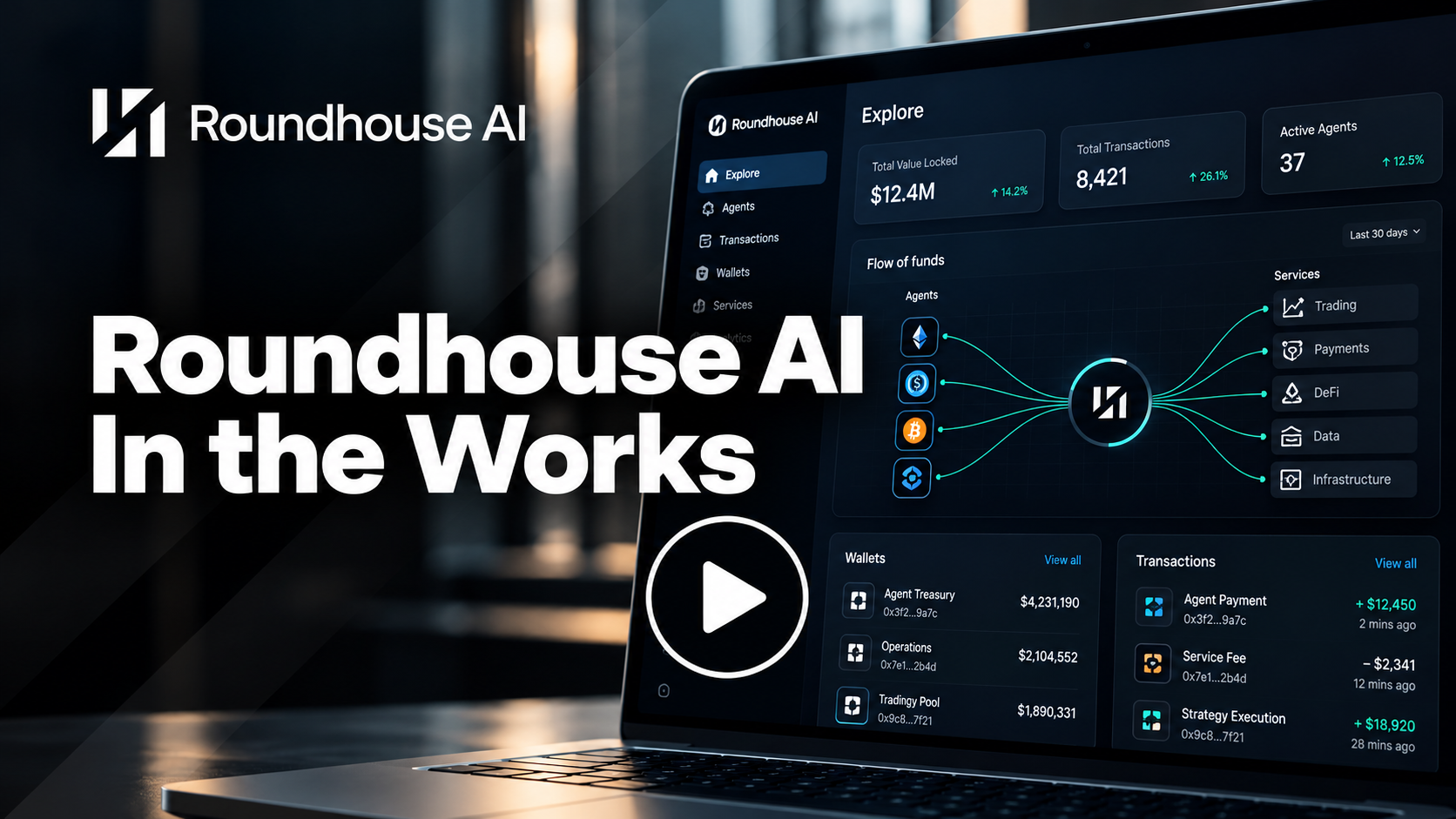
AI agents are beginning to act, pay, access APIs and use software autonomously. Roundhouse is targeting the trust layer behind that activity; creating a record of who acted, under whose authority, against which endpoint, with what payment proof and with what outcome.
Roundhouse's strategy begins with its free x402 Facilitator, designed to capture agent-payment activity and build the underlying data asset. That data feeds an Indexed Reputation Graph, which could ultimately support commercial Agent Reputation Scores and the aGDP premium data product.
The Broker Note sets out a conditional 12–18 month valuation framework, including a Proliferation scenario of approximately 12p–31p, with 20p as a midpoint reference if key product, AIM, adoption and financing milestones are achieved. A 40p+ outcome is reserved for a substantially stronger "Moat" scenario rather than treated as a price target.
Roundhouse AI is being positioned as a listed infrastructure play on the emerging agent economy. The central investment question is whether the Company can become the trusted data and scoring layer for autonomous-agent activity: recording what agents do, building a reputation graph from that activity, and later selling decision-useful scores and machine-economic data to counterparties that need to manage agent risk.
Artificial intelligence agents are moving from passive tools into active economic actors. They can retrieve data, call APIs, access software and initiate payments. As this shift gathers momentum, the market's limiting question changes from whether an AI model can produce a useful answer to whether an agent can be trusted to act.
Roundhouse AI's proposed answer is a trust, scoring and data architecture for autonomous economic activity. The core pathway is straightforward: free facilitator adoption creates settlement data; indexed settlement data creates the reputation graph; the reputation graph supports agent scoring; and the recognised scoring and activity dataset can then support institutional index and data products.
.png)
Fill out the short form below to get instant access to this free report revealing our Top 10 Small Cap stock picks for October 2026.
Nothing in the above article should be considered investment advice.
Small Cap or AIM listed companies can be highly illiquid making them difficult to sell at the quoted price, and in some cases, it may be difficult to sell them at any price. Small Cap or AIM listed companies can have a large bid / offer spread which means there could be a large difference between the buying and selling price. Companies listed on the AIM market can be highly volatile and are considered high risk speculative investments. The value of your investment can go down as well as up, your Capital is at risk you may not get back the amount invested. Past performance is no guarantee of future performance. Please ensure that you fully understand the risks involved. If in any doubt, please seek independent financial advice. This document is published by Clear Capital Markets and does not constitute a solicitation or personal recommendation for the purchase or sale of investment. The investments referred to may not be suitable for all investors. Any data or views given should not be construed as investment advice. Every effort is made to ensure the accuracy of the information, but no assurance or warranties are given. Clear Capital Markets Limited is authorised and regulated by the Financial Conduct Authority FRN 706689.
Clear Capital Markets Corporate Broking acts as a Corporate Broker to Roundhouse AI and holds warrants and shares in the company. Employees and/or directors of Clear Capital Markets may deal in shares of Roundhouse AI for their own personal accounts. These scenarios may give rise to a conflict of interest where Clear Capital Markets also provides clients with an advisory service for transactions involving Roundhouse AI. The firm has established Conflicts of Interest (“COI”) and Personal Account Dealing (“PAD”) policies to mitigate the risk of a conflict causing damage to the interests of its clients. The measures taken include (i) enforcing minimum holding or ‘lock-in’ periods; and (ii) requiring internal review and approval from the compliance department for employees or directors entering into personal transactions involving Roundhouse AI. The COI and PAD policies are available upon request. Before Clear Capital Markets proceeds with a placing, a number of factors are considered including liquidity of stock, company diversification, market capitalisation and potential news flow. Only once minimum criteria are satisfied would we elect to proceed. Any remuneration payable to Clear Capital Markets has no bearing on whether it proceeds with a placing. These administrative controls mitigate the risk of a conflict causing damage to the interests of a client, but the inherent risks of this business model cannot be eliminated. Accordingly, Clear Capital Markets is required to disclose this conflict to help clients assess the service being offered in light of Clear Capital’s own interests, and to decide on the extent (if at all) to which they will rely on, or proceed with, the service.


